The service cuts arriving this month were not caused by this month. They were determined several years ago, on the day large sums of non-recurring money were paid into systems whose costs recur every single day.
Nobody involved was foolish. An agency handed money during a collapse in ridership, with an obligation to keep buses running, put the money into keeping buses running. Any other choice would have been indefensible at the time. But the arithmetic was fixed from the start, and the date was knowable.
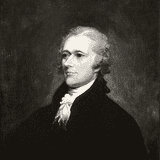
Alexander Hamilton built his career on precisely this distinction, in a country that had defaulted on everything and could borrow nothing.
The pledge, not the promise
The part of his 1790 plan that people remember is the assumption of the debts. The part that actually worked was narrower and duller.
He did not simply promise that the debts would be paid. He pledged specific, permanent revenues — chiefly the import duties — to servicing them, in the same instrument, so that a person holding the paper could see the stream the payment would come out of and satisfy themselves that it did not depend on anyone's goodwill next year.
That is what created credit. Not the intention to pay, which every defaulting government has, but a named recurring revenue attached to a named recurring obligation. His test for any engagement was exactly that: is there a specific fund pledged to this, or is there only a promise?
The distinction is invisible in a single year's accounts, where a grant and a tax look identical — money in, expenses covered, budget balanced. It becomes visible only at the moment the non-recurring source stops, and by then the obligation has been in place long enough to have shaped where people live and how they get to work.
The test, run forward
The useful version of this is not a diagnosis of what happened to transit. It is a test any organisation can run this week, and it takes an hour.
List the recurring commitments — the things that will exist next year and the year after. Then, beside each, name the recurring revenue pledged to it.
Where you can name one, the commitment is funded and you can plan against it.
Where you cannot, you do not have a risk. You have a scheduled event, and the useful move is to compute its date and put it in front of whoever will have to act, while there is still time for the action to be something other than a cut. An obligation supported by a non-recurring source is not underfunded. It is funded until a date, and the difference between those two descriptions is the difference between a warning and a surprise.
This is one of those cases where the honest analysis is available years early and is unwelcome years early, which is why it is rarely done.
Watch out for
His own funding system has an objection attached that applies directly to the rule above, and he heard it at the time.
Pledging revenue to existing obligations rewards whoever already holds the paper. His plan paid the speculators who had bought up soldiers' certificates at a fraction of face value, and paid the soldiers who had sold them nothing at all. He knew, and overrode it, on the reasoning that a market in which claims could not be transferred reliably would be no market.
The version here is not identical but it rhymes. A rule that says fund only what has a pledged revenue will systematically favour jurisdictions that already have a tax base, and will lock in the existing geography of who has service and who does not. Applied without that in view, the discipline is a way of making an unequal distribution permanent and calling it prudence.
There is a second caution his critics pressed. Because contingencies are limitless, this style of reasoning always argues toward more revenue and more authority at the centre, and it produces no stopping rule of its own. And his own low estimate of popular judgement cost him the standing that his designs needed to survive — a reminder that a correct fiscal structure with no constituency behind it does not last either.
Answer this next
Take the three commitments your organisation could least afford to stop, and name the recurring revenue pledged to each.
Where you cannot name one, work out the date. That date is the only part of this that is still negotiable.