Think of something you are half-deciding to buy. The upgrade, the course, the bigger place, the car with the thing you wanted. You know the price. You have probably worked out the monthly figure, and whether the monthly figure fits.
Now change the unit.
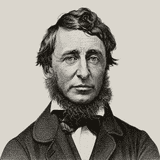
Thoreau's first question about anything was not whether it was good but what it cost — and he refused to let cost be measured in money. In Walden he put it this way: "the cost of a thing is the amount of what I will call life which is required to be exchanged for it, immediately or in the long run."
You may know that line in a tidier form. The version that circulates is shorter, swaps his cost for price, and drops the hesitation in the middle — and it has sat inside quotation marks for so long that almost nobody checks it against the book. His own sentence is clumsier and more careful, and the awkward bit is the good bit: what I will call life, because he knows he is proposing a unit of measurement and wants you to catch him doing it.
The exchange rate
The arithmetic is unglamorous. Take what you actually keep from an hour of work — after tax, after the commute, after the things you only pay for because you have the job. Divide the purchase by it. You now have the price in mornings.
Nearly everyone finds the number is worse than they expected, and for a reason that has nothing to do with willpower. Sticker prices are quoted against gross salary in our heads and paid out of net, so the gap between what a thing costs and what it costs you is invisible at exactly the moment you decide. A four-figure purchase is not a fifth of a month's pay. It is a fortnight of getting up in the dark.
That is the whole method, and its usefulness is that it does not moralise. Some things survive the conversion easily — the ones that give back time, or that you would still buy at double the hours. Others quietly do not survive being written down at all, and those are almost never the extravagances. They are the ordinary recurring things nobody has re-examined since the day they started.
Watch out for
Now the part that should make you hold the method more loosely, because it is about the man who built it.
Thoreau's ledger — the famous itemised one, printed to prove the whole thing was checkable — had holes in it. The axe he built the cabin with was borrowed. The land was Emerson's. The cabin stood a mile and a half from Concord and he strolled into the village every day or two, where he ate. The accounts explicitly except washing and mending, most of which was done out of the house, and whose bills he notes had not yet come in.
He never claimed complete self-sufficiency, and he told at least one admirer he would not want anyone to copy his way of living. But the book invites the reading, and the reading is wrong. The model is only ever as honest as the items admitted to it — which is the sharpest possible warning to give someone about to convert their own life into hours and feel very clever about the result.
The second thing: the conversion assumes hours you can actually move. Someone working the shifts they are given, with no discretion at either end, gets no lever from this at all — and telling them the problem is their spending is the oldest and least useful advice there is.
Answer this next
Take the largest recurring payment you have not looked at in a year. What does it cost you in mornings?