The detection tools are being switched off. Not because anyone decided the problem had gone away, but because the detectors were wrong often enough that acting on them was indefensible, and the accusation they generated fell hardest on students writing in a second language. What is replacing them is older than any of it: the invigilated paper, the in-class piece, the conversation in which somebody asks you what you meant.
Read as a security measure, that is a retreat. Read as an assessment decision, it is something else, and the older reading is the useful one.
What the questioning was ever for
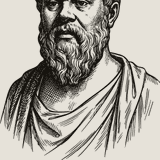
Socrates left no writing at all. The whole of his method, as it reaches us, is cross-examination: take the confident general claim — courage, justice, a good essay — ask the person to define it, then test the definition against cases until it either holds or contradicts itself.
The point of that, and the reason it matters here, is that it cannot be done on your behalf.
A finished essay is an artefact. It has always been indirect evidence: you infer from the artefact that a process happened in someone's head, and the inference held for as long as producing the artefact required the process. That link is the thing that broke. It did not break because students became dishonest. It broke because the artefact became separable from the process, and an assessment resting on an inference that no longer holds is not a strict assessment or a lax one. It is measuring something else.
Questioning restores the link by moving the assessment to the only place the work cannot be handed off: the moment after the answer, when somebody asks what you meant by the third word.
Three questions that do most of the work
The method compresses into a short sequence, and it does not need a formal viva to run.
Define the central term in your own words, without the sentence you wrote. Most fluent work has one load-bearing abstraction in it, and the difference between a student who built the argument and one who received it usually appears within a sentence of being asked to restate it.
Give me a case where your claim fails. Anyone holding a real position knows where its edges are. A position that was assembled rather than reasoned tends to have no edges at all, because nothing in its production ever pushed on them.
What would change your mind? This is the one that separates a defensible answer from a well-formed one, and it is the question a finished document almost never contains.
Watch out for
The serious objection to this method is that it breaks things and does not build them. Cross-examination reliably shows a person that their answer fails. It very often leaves them with nothing to replace it, and a student who leaves the room knowing only that they could not defend their position has been assessed rather than taught. Athens found the experience irritating enough to vote for hemlock, and it is worth remembering that the irritation was not entirely unreasonable.
The second objection belongs to the modern instrument rather than to him, and it is the one that will decide whether this works. An oral assessment measures fluency under pressure along with understanding, and it cannot easily tell them apart. That penalises the anxious, the student examined in a second language, the autistic student, the one who thinks slowly and well. It is also enormously expensive, and an institution that scales it to several hundred students will do it in eight-minute slots with tired examiners, at which point the reliability is worse than the essay it replaced and the bias is harder to appeal.
Neither is a reason to keep pretending the artefact still proves what it used to. Both are reasons to write down, in advance, what the questioning is for — and to give a student who fails it something to do next.
There is also a limit on the source. Socrates wrote nothing, so the method is a reconstruction from two men who disagreed about him, and anything confident about how he ran a conversation is a reading of Plato.
Answer this next
Take the last thing you were assessed on, or the last thing you assessed, and write the single follow-up question that would separate someone who understands it from someone holding a fluent account of it.
If you cannot write that question, the assessment was never measuring understanding — and that was true before any of this.