Two things happened this summer that are being reported as the same thing. Reservoirs and rivers fell to levels not seen in the record. And in several places the ground itself went down, because water was drawn out of the clay beneath it and the clay closed up.
Only one of those comes back when it rains.
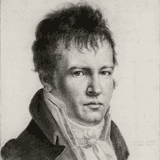
Alexander von Humboldt spent four years in South America measuring things nobody had thought worth measuring, and the single most useful habit he left is a way of reading a landscape that treats it as a record of decisions rather than as a fact about nature.
What was done here, and when
In 1800 he reached Lake Valencia in what is now Venezuela and found the water level falling. The planters around it had an explanation ready: the lake was draining away underground, into some subterranean channel. It was a mystery, and therefore nobody's doing.
He took levels, examined the shoreline, walked the catchment, and reached a duller answer. The forest above the lake had been cleared for indigo and cotton. Cleared slopes hold less and shed faster, streams that had fed the lake had been diverted to irrigate the plantations, and the evaporating surface had grown. The lake was not a mystery. It was an account of what had been done in the valley over about thirty years, and the people calling it a mystery were the people who had done it.
His general rule came out of episodes like that: before explaining what a place is, establish what people have done to it, in which decade, on whose orders — and which of the consequences have not arrived yet.
Three quantities, reported as one
Run that on a water headline and it separates into parts that behave completely differently.
The first is weather. This year's precipitation and temperature, which vary, which will vary back, and which are the part everyone reports because they are the part that changes fastest.
The second is allocation. Who is entitled to how much, under rules mostly written decades ago, when the hydrology was estimated from a period we now know was unusually wet. That quantity does not vary with the weather at all. It varies with law, and it is the reason a shortage arrives as a legal question about priority rather than as a physical one about supply.
The third is permanent loss. When groundwater is pumped out of a compressible layer, the layer compacts. The land surface drops, and the pore space that held the water is gone. A wet decade does not restore it. This is the quantity that fits his rule most exactly, because it is a consequence of past pumping that arrives long after the pumping, and it converts a temporarily depleted store into a permanently smaller one.
A reader who separates those three can do something a reader who does not cannot: tell which parts of a crisis are cyclical, which are political, and which are already settled and cannot be argued with.
Watch out for
A mind expecting everything to be connected finds connection everywhere, coincidence included, and prefers a grand linking scheme to a dull local cause. Humboldt's own plan for Cosmos widened from a physical geography to a description of the entire universe and was unfinished when he died at eighty-nine. Applied here, the temptation is to make every local shortage an instance of one global story, when the binding constraint is often a specific diversion, a specific well field, a specific rule about priority.
The second failure is moral rather than analytic, and it is his. This model reliably turns environmental facts into fables about human folly, and generalises from the particular planters he watched to humanity as such — while the observations themselves were gathered under a royal passport, inside the estates, missions and mines whose conduct they indict. He was a guest of the extraction he was documenting, and his method gave him no way to see that.
And the figures deserve his other caution. Whatever resists measurement drops quietly out of the account, and a number printed with a confident decimal acquires an authority the instrument never had. His own barometric heights were treated as settled long after better instruments revised them.
Answer this next
For the supply your own household or business depends on, find out which of the three quantities is actually moving: the weather, the allocation rule, or the storage itself.
The first will change back. The second can be argued about. The third is the one worth knowing about before anybody tells you a wet winter has fixed it.