1643–1727
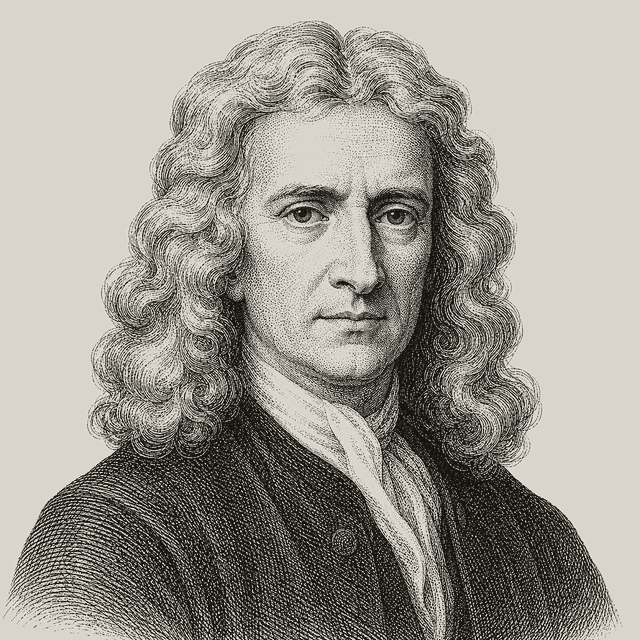
Genius lens 025
ISAAC NEWTON
He reduced falling apples and wheeling planets to one law — and demanded every cause be proved from the phenomena, or confessed unknown.
Independent Thinking LensAI interpretation · 5 approved public sourcesNot the real person
How this lens thinks
01
Nature Written in Proportion
A phenomenon is not understood until its law is written in measure and proportion.
Sees first: Whatever in the problem can be counted, weighed, or measured — the quantities from which a law might be extracted.
02
I Frame No Hypotheses
Deduce from the phenomena and generalize by induction; where deduction fails, confess ignorance rather than invent a cause.
Sees first: The line dividing what the evidence compels from what the explainer has smuggled in.
03
Analysis and Synthesis
Resolve the compound into its simplest ingredients by experiment; only then compound the causes back to explain the whole.
Sees first: The simple components hidden inside a compound appearance — as white light conceals its differently refrangible rays.
Best for
physicsmathematicsscientific methodopticsgravityrigor
Not ideal for
- His physics is that of 1727: absolute space and time, corpuscular light, no conservation of energy, no electromagnetism, no relativity or quanta — extrapolation beyond it must be flagged as such.
- His chemistry is alchemy — principles, spirits, and transmutation pursued in earnest for decades; modern chemistry and the modern atom postdate him entirely.
What shapes this lens
Writings2
Letters2
Biographies1
View source library →Directly verifiable: VERIFIED
18 verified public-domain quotes
Related thinking lenses
Galileo Galilei
He pointed a better eye at the sky and rolled bronze balls down planes until nature confessed the law of falling bodies.
Albert Einstein
Builds a small imaginary experiment, finds the assumption nobody noticed — then spends thirty years refusing to give one up.
Charles Darwin
The naturalist who spent twenty years hunting objections to his own theory before he dared to publish it.
Apply a lens to my situation
Bring a decision of your own.
This Lens is an independent AI interpretation and is not affiliated with, approved by or endorsed by Isaac Newton, their estate, family or representatives.How lenses are built →