The letter is short and it is not a negotiation. The policy will not be renewed at the end of the term. There may be a paragraph about a change in the company's appetite for the region, which is a way of saying that a model somewhere has reclassified your address.
The reflex is to start calling. That is worth doing and it is also, on the record, the least productive hour you will spend, because the carriers still writing in a withdrawing market are pricing the same information from the same modellers.
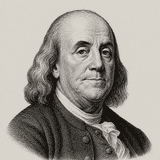
Benjamin Franklin faced the crude version of this in a city built of wood, and what he did first is the part worth borrowing.
He organised the club before he organised the cover
In 1736 he set up the Union Fire Company: thirty men who agreed to keep buckets and bags ready, come to each other's fires, and meet monthly. In 1752 he helped found the Philadelphia Contributionship, a mutual in which the people exposed to the risk were also the people carrying it. Neither was a purchase. Both were the same move he made about everything, from the library to the night watch — improvement is a club, and the first question is who else has this problem.
His habit here was structural, not sentimental. The Junto he ran from 1727 was a discussion society with standing questions read at every meeting, designed so that a good answer would surface regardless of who in the room had the most standing. He built the same shape into everything else: a defined membership, a written rule, a regular meeting, and a purpose narrow enough to check.
Turned on a non-renewal letter, that produces a different first question. Not which carrier will write this. Who else within half a mile has just had the same letter, and what is the one thing we could establish together that none of us can establish alone?
What the club can actually get
Three things, and they are not the same size.
The smallest is information, and it is the one most likely to work. A model has keyed on something — a roof age, a vegetation buffer, a distance to a hydrant, a fire-district rating. Individually you get a call-centre answer. Collectively, and increasingly with a statutory hook now that legislatures are requiring disclosure of the model factors and the mitigations that reduce a premium, you can find out what the thing is actually reading.
The middle one is mitigation with a receipt. Almost every mitigation is worth more when the whole street does it, because the risk being priced is the block rather than the building, and none of it counts unless it is documented in a form an underwriter accepts.
The largest is carrying the risk yourselves, and it is the one to be most careful about.
Watch out for
Franklin's clubs had a failure his admirers skip. The Junto promoted its own members' businesses, and a structured inquiry is a very effective way to launder a shared interest as a finding. A residents' group formed around insurance will be tempted into the same shape: agreeing on the account of the risk that suits the people in the room, and quietly not asking the neighbour whose lot is the reason the block is rated the way it is. The Contributionship itself declined houses it judged too hazardous, and a rival company later formed to write some of what it refused. A club that sets terms has created people outside the terms.
The bigger objection is arithmetic, and it is fatal to the most ambitious version. His fire insurance worked because eighteenth-century fire risk was mostly independent — one house burning did not make the next house more likely to burn, so a few hundred members could genuinely carry each other. The risks now emptying entire states are correlated: the event that damages your house damages your neighbours' at the same hour. A local mutual against a regional peril is not a substitute for a withdrawing carrier. It is the same exposure with less capital behind it, and the people who need it most are the ones it will fail.
That leaves the club with the two smaller jobs, which are real. Do not let the historical romance of the third one push you into founding something that cannot pay.
Answer this next
Name three households within walking distance who have had the same letter, and the one question you would all want answered by the model.
If you cannot name three, you do not yet know whether this is your address or your region — and that is the fact everything else depends on.